


SUSTAINABILITY
What are emulsifiers, and how do they work?
Release time:
2024-11-26 13:57
Source:
What are emulsifiers, and how do they work?
Add oil to water, and the two liquids will never mix—at least not until an emulsifier is introduced. Emulsifiers are what prevent the oil from separating from the vinegar in mayonnaise, enable chocolate to be molded into various bars, and keep bread from spoiling so easily.
This article examines what emulsifiers are and in which foods they play a crucial role.
What are emulsifiers, and how do they work?
An emulsifier is a food additive used to help blend two substances that would normally separate when combined, such as oil and water.
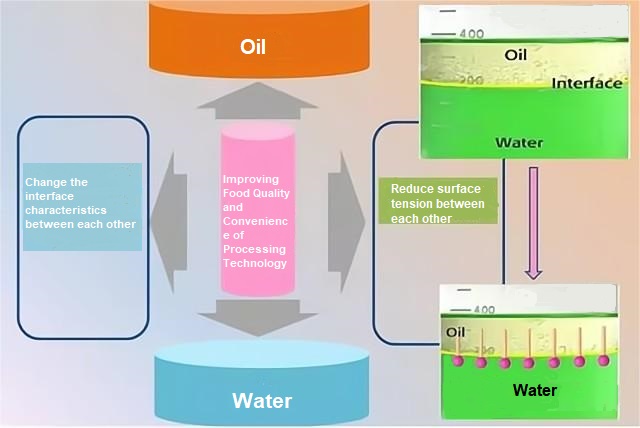
Emulsifiers have a hydrophilic end and a lipophilic end. When added to immiscible liquids, emulsifier molecules orient themselves at the so‑called interface, where oil and water are separated.
Here, the emulsifiers are positioned such that their hydrophilic ends face the aqueous phase and their hydrophobic ends face the oil phase, enabling the water and oil to be finely dispersed relative to one another. Ultimately, the emulsifiers stabilize the emulsion, yielding a uniform, smooth product.
How do emulsifiers work?
Emulsifiers play a crucial role in food manufacturing, enhancing appearance, flavor, texture, and shelf life.
Today, many of the foods we consume—such as margarine, mayonnaise, creamy sauces, confectionery, packaged processed foods, candies, and a wide range of baked goods—would not exhibit their characteristic properties without the addition of emulsifiers.
The main functions of emulsifiers are:
Fatty acid monoglycerides and diglycerides/glycerol monostearate E471 (GMS DMG): emulsification, dispersion, and anti‑staling.
Sodium stearoyl lactylate E481 (SSL): strengthens, emulsifies, delays aging, and preserves freshness; increases the volume of bread and mantou and improves their texture.
Stearoyl Lactate E481–482 (CSL–SSL): strengthens, emulsifies, delays staling, preserves freshness, increases the volume of bread and mantou, and improves texture.
Polyglycerol esters of fatty acids E475 (PGE): strong emulsifying, moisturizing, and softening properties; prevents starch retrogradation and aging.
Diacetyl tartaric acid esters of monoglycerides and diglycerides, E472e (DATEM): acts as an emulsifier, enhances dough elasticity, tenacity, and gas‑retention capacity, increases the volume of bread and steamed buns, and helps prevent staling.
Glyceryl monolaurate (GML): emulsification, dispersion, preservation, and shelf-life extension.
Span and Tween series (e.g., S-60, T-60): excellent emulsifying, stabilizing, dispersing, and wetting properties.
Sucrose fatty acid esters (SE): emulsification, solubilization, foaming, and anti‑aging.
Propylene Glycol Stearate (PGMS): delivers a crisp, refreshing mouthfeel, excellent foaming performance, and superior anti‑aging properties.
Previous Page
Previous Page
Related News

Tel: +86-20-3848 0078
Fax: +86-20-3848 0779
Email: info@gzcardlo.cn
Office: 7th Floor, North Tower, Ruihua Building, 267 Wushan Road, Tianhe District, Guangzhou City, Guangdong Province, China.
Factory: No.6 Huafeng Road, Yonghe District, Economic and Technological Development Zone, Guangzhou City, Guangdong Province, China.
©2023 Guangdong Cardlo Biotechnology Co., Ltd. All Rights Reserved